


Africa’s top ten exporters of physical goods tell a clear story: South Africa and Morocco are far ahead of the rest of the continent.
Merchandise exports show how much a country sells to the world in goods. This includes fuel products, minerals, metals, food & agricultural items, garments, electronics, machines, vehicles, and other physical raw materials and intermediate/finished goods.
It’s a good measure of the true strength of a country’s production power and economic health as it measures global demand for a nation’s output.
Here’s how the top 10 breaks down based on 2025 data:
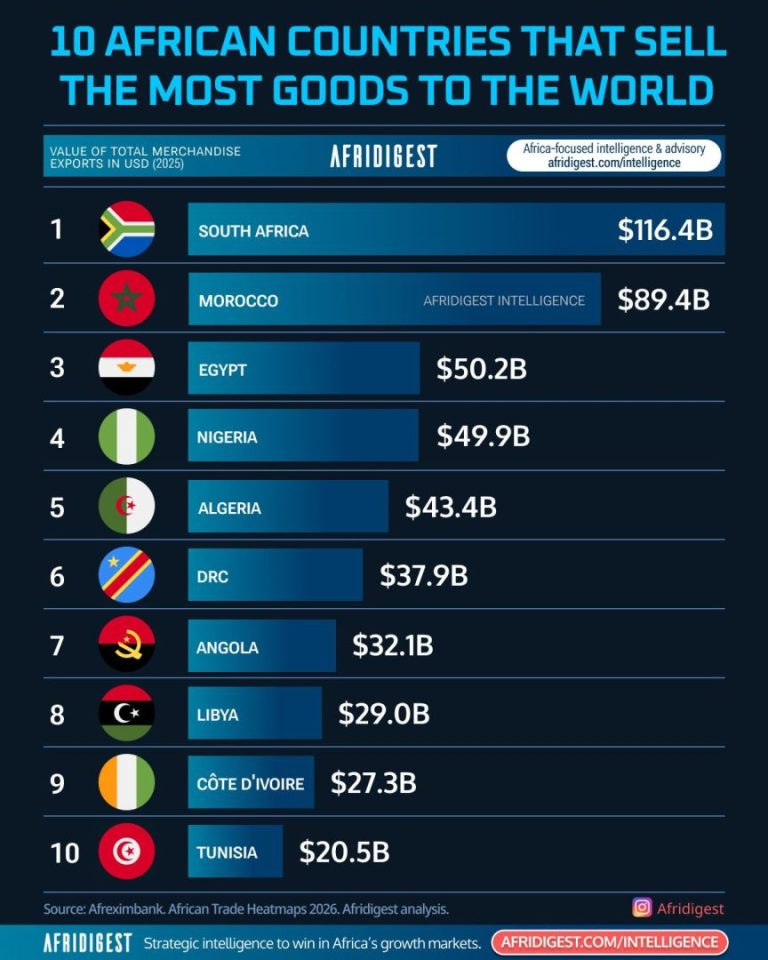
🇿🇦 South Africa ($116.4B)
- Key Drivers: Highly diversified compared to peers.
- Main Exports: Platinum group metals & gold, diamonds, ores & coal, cars & automotive parts, agrifood products.
🇲🇦 Morocco ($89.4B)
- Key Drivers: Strong integration into European manufacturing chains.
- Main Exports: Cars & automotive parts, electrical wiring, fertilizers & phosphates, agrifood products, textiles.
🇪🇬 Egypt ($50.2B)
- Key Drivers: Industrial manufacturing and strategic geographic positioning between Africa, the Middle East, and the Mediterranean.
- Main Exports: Refined petroleum & crude oil, gold & precious stones, fertilizers, agrifood products, textiles.
🇳🇬 Nigeria ($49.9B)
- Key Drivers: Massive oil dependency, though domestic refining capacity is shifting dynamics.
- Main Exports: Petroleum and natural gas account for over 85% of total export value.
🇩🇿 Algeria ($43.4B)
- Key Drivers: State-controlled hydrocarbon wealth linked closely to European energy demand.
- Main Exports: Petroleum and natural gas account for over 90% of total export value.
🇨🇩 DRC ($37.9B)
- Key Drivers: The global green energy transition has supercharged demand for its minerals.
- Main Exports: Critical minerals & metals — led by copper & cobalt — account for ~90% of total export value.
🇦🇴 Angola ($32.1B)
- Key Drivers: Heavy hydrocarbon reliance, similar to Nigeria and Algeria.
- Main Exports: Hydrocarbons & mining extracts — petroleum, natural gas, & diamonds — account for 95% of total export value. Crude oil alone accounts for ~80%.
🇱🇾 Libya ($29.0B)
- Key Drivers: Economy is almost entirely dependent on its vast oil reserves.
- Main Exports: Crude petroleum, natural gas, and refined petroleum account for over 95% of total export value.
🇨🇮 Côte d’Ivoire ($27.3B)
- Key Drivers: The agricultural powerhouse of West Africa.
- Main Exports: Cocoa beans/products, crude petroleum, coffee, rubber, gold.
🇹🇳 Tunisia ($20.5B)
- Key Drivers: Focused heavily on diversified manufacturing with high integration into European value chains.
- Main Exports: Electrical machinery, insulated wiring, textiles & clothing, olive oil & other agrifood products.
The list above is dominated by extractives — a structural reality of African markets today.
As a continent, 50-55% of total export value comes from hydrocarbons and mining.
Across Africa, in country after country, moving up the value chain to refine and process petroleum, mineral, and metal goods that are currently exported raw remains a key opportunity.
After all, export power is national earning power.


Share: