


The World Bank Group has released its country income classifications for FY27 (July 1, 2026–June 30, 2027), based on 2025 GNI per capita.
Two changes stand out for Africa: Togo moves from low income to lower-middle income (due to a revision of its population estimate); Ethiopia, unclassified for the past year due to a data gap, re-enters the system as a low-income country.
Here’s the continent, tier by tier.
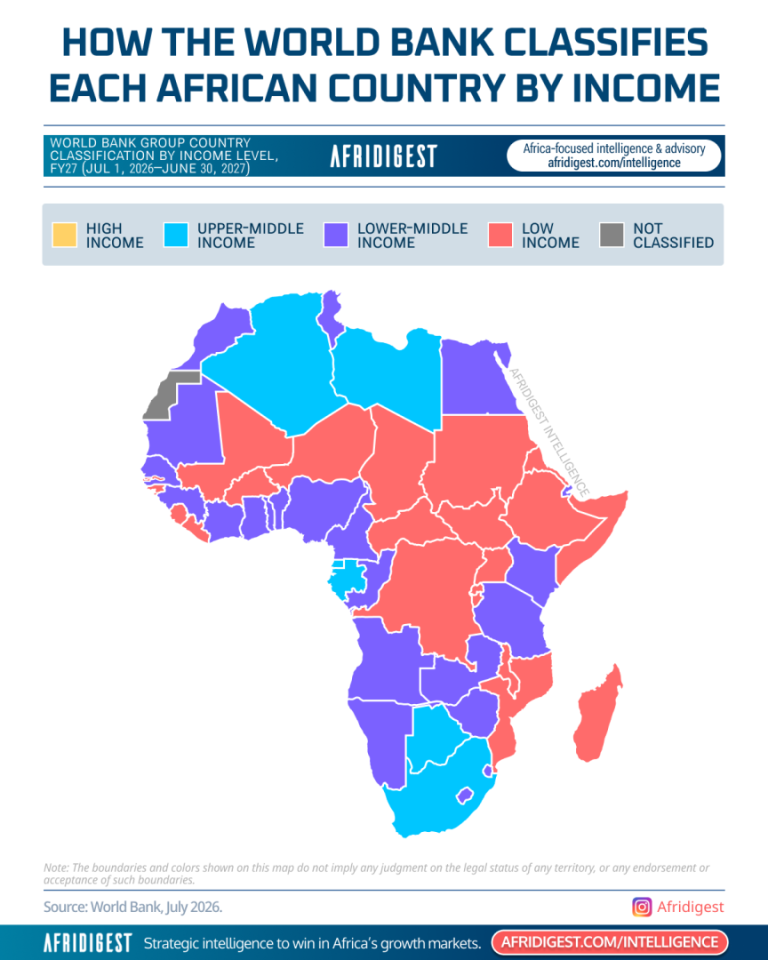
THE BREAKDOWN
- 🟡 High income — 1 country (2%)
- 🔵 Upper-middle income — 8 countries (15%)
- 🟣 Lower-middle income — 24 countries (44%)
- 🔴 Low income — 21 countries (38%)
- ⚫ Not classified — 1 country (2%)
HIGH INCOME (1) — above $14,376
- 🇸🇨 Seychelles
UPPER-MIDDLE INCOME (8) — $4,636–14,375
- 🇩🇿 Algeria
- 🇧🇼 Botswana
- 🇨🇻 Cabo Verde
- 🇬🇶 Equatorial Guinea
- 🇬🇦 Gabon
- 🇱🇾 Libya
- 🇲🇺 Mauritius
- 🇿🇦 South Africa
LOWER-MIDDLE INCOME (24) — $1,176–4,635
- 🇦🇴 Angola
- 🇧🇯 Benin
- 🇨🇲 Cameroon
- 🇰🇲 Comoros
- 🇨🇬 Congo, Rep.
- 🇨🇮 Côte d’Ivoire
- 🇩🇯 Djibouti
- 🇪🇬 Egypt
- 🇸🇿 Eswatini
- 🇬🇭 Ghana
- 🇬🇳 Guinea
- 🇰🇪 Kenya
- 🇱🇸 Lesotho
- 🇲🇷 Mauritania
- 🇲🇦 Morocco
- 🇳🇦 Namibia
- 🇳🇬 Nigeria
- 🇸🇹 São Tomé and Príncipe
- 🇸🇳 Senegal
- 🇹🇿 Tanzania
- 🇹🇬 Togo
- 🇹🇳 Tunisia
- 🇿🇲 Zambia
- 🇿🇼 Zimbabwe
LOW INCOME (21) — $1,175 or less
- 🇧🇫 Burkina Faso
- 🇧🇮 Burundi
- 🇨🇫 Central African Republic
- 🇹🇩 Chad
- 🇨🇩 Democratic Republic of the Congo
- 🇪🇷 Eritrea
- 🇪🇹 Ethiopia
- 🇬🇲 Gambia
- 🇬🇼 Guinea-Bissau
- 🇱🇷 Liberia
- 🇲🇬 Madagascar
- 🇲🇼 Malawi
- 🇲🇱 Mali
- 🇲🇿 Mozambique
- 🇳🇪 Niger
- 🇷🇼 Rwanda
- 🇸🇱 Sierra Leone
- 🇸🇴 Somalia
- 🇸🇸 South Sudan
- 🇸🇩 Sudan
- 🇺🇬 Uganda
NOT CLASSIFIED (1)
- 🇪🇭 Western Sahara — no reported economic data
Notably, Africa holds the vast majority of the world’s low-income countries — 21 of 25. The other four are Afghanistan, North Korea, Syria, and Yemen, all conflict-affected or heavily sanctioned states.
That’s the snapshot. The trend line is more encouraging.
In sub-Saharan Africa specifically, the share of countries classified as low-income fell from 75% in 1987 to ~44% today, per World Bank data.
There’s still a long way to go and much more needs to happen across the continent — and urgently — but the overall direction across the last four decades is clear.
Read the July 2026 World Bank income classification release here.
Decision-makers across the continent and the world trust Afridigest for Africa-focused intelligence & advisory → Afridigest Intelligence
Sign up here to receive the Afridigest newsletter in your inbox.




Share: